From research to knowledge: three scientific publications with Prudêncio’s participation
When talking about innovation in construction, it is common to think of new materials, construction systems, or technologies applied on site. However, there is an equally important, although less visible, stage: the generation and sharing of scientific knowledge.
It was precisely in this context that Prudêncio participated as co-author of three scientific review articles, developed within the scope of the EcoSys2Build and MI3S research projects. The three articles were published in international open-access scientific journals, allowing researchers, companies, and professionals from around the world to consult and use this knowledge.


Why is it important for a company to participate in scientific articles?
Innovation happens when scientific knowledge and practical experience work together.
By taking part in the production of scientific articles, companies such as Prudêncio help bring research closer to the real needs of the market, contributing to the transformation of knowledge into applicable solutions.
This participation also makes it possible to:
- Strengthen technical credibility within the sector;
- Share knowledge with the scientific and industrial community;
- Identify new innovation opportunities;
- Establish strategic partnerships with universities, research centres, and other companies;
- Promote an internal culture of continuous improvement and technological development.
More than simply disseminating results, publishing knowledge is also a way of contributing to the evolution of construction.
The role of review articles
Unlike an experimental study, a review article brings together and analyses dozens or hundreds of scientific works already published on a specific topic.
Its purpose is to organise existing knowledge in order to:
- Identify trends;
- Identify knowledge gaps;
- Highlight the main challenges;
- Support new lines of research;
- Accelerate knowledge transfer between academia and industry;
- Provide validated technical information in a clear and structured way.
For companies investing in research and development, these reviews are an important tool for anticipating trends and supporting strategic decisions.
Article 1 | Lignocellulosic materials for sustainable construction systems
Integration and Challenges of Lignocellulosic Materials into Bio-Based Construction Systems
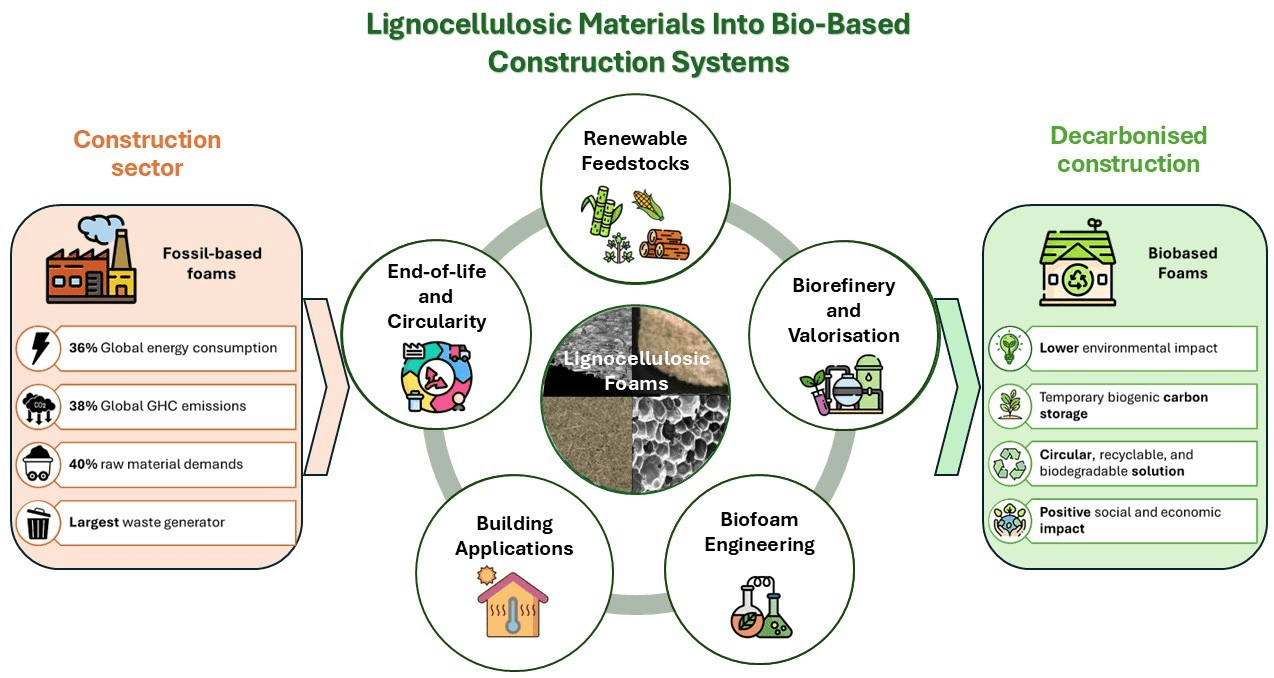
Source: Graphical abstract reproduced from Vieira ES, Damaceno T, Costa JJ, et al. Integration and Challenges of Lignocellulosic Materials into Bio-Based Construction Systems. Macromol. 2026;6(2):30. https://doi.org/10.3390/macromol6020030. Reproduced under the Creative Commons Attribution 4.0 International licence (CC BY 4.0).
Developed within the scope of the EcoSys2Build project, and co-authored with CeNTI, ISEP, Itecons, and Painel 2000, this article analyses the potential of lignocellulosic biomass, composed of materials such as cellulose, hemicellulose, and lignin, in the development of bio-based insulation foams for construction.
The document brings together the latest scientific advances and compares the performance of these materials with the synthetic systems currently in use. Essential properties are assessed, including thermal insulation, mechanical resistance, dimensional stability, fire behaviour, and moisture resistance.
Although the results show that these solutions can achieve highly competitive performance, the article also identifies the main challenges that still need to be overcome, such as cost, industrial scalability, standardisation, and market integration.
The publication highlights the potential of these materials to contribute to more sustainable and circular construction, with a lower carbon footprint.
Due to the scientific relevance of the work developed, this article was selected to illustrate the cover of the scientific journal in which it was published.
Full article: https://www.mdpi.com/2673-6209/6/2/30
Article 2 | The evolution of tannin-based phenolic foams
Innovations in Tannin-Based Phenolic Foams: A Review of the Research
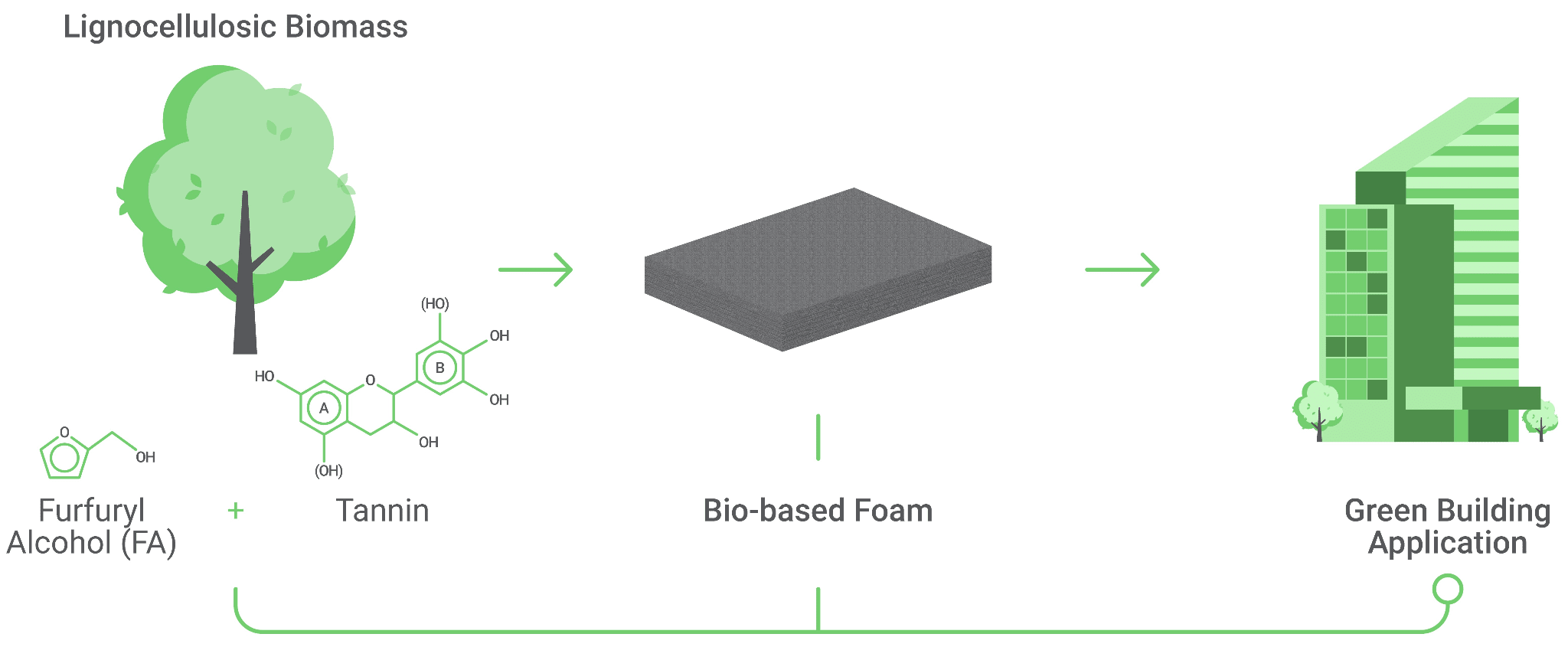
Source: Graphical abstract reproduced from Abreu AG, Costa JJ, Santos PF, et al. Innovations in Tannin-Based Phenolic Foams: A Review of the Research. Macromol. 2026;6(1):10. https://doi.org/10.3390/macromol6010010. Reproduced under the Creative Commons Attribution 4.0 International licence (CC BY 4.0).
Also integrated into the EcoSys2Build project, and co-authored with ISEP, this article presents a comprehensive review of the evolution of phenolic foams produced from tannins, natural plant-based compounds that represent a more sustainable alternative to fossil-based raw materials.
Different formulations developed in recent years are assessed, showing how the replacement of traditional components, such as formaldehyde and certain blowing agents, which are extremely harmful to both humans and the environment, contributes to obtaining materials with improved thermal, mechanical, and fire-resistance properties, while also reducing their environmental and human health impact.
The article also addresses Life Cycle Assessment (LCA) studies, reinforcing the potential of these foams as innovative solutions for thermal insulation and future structural applications in sustainable construction.
Full article: https://www.mdpi.com/2673-6209/6/1/10
Article 3 | Nature-inspired smart sensors
Nature-Inspired Trojan Materials as Invisible Enablers of Advanced Humidity Sensors
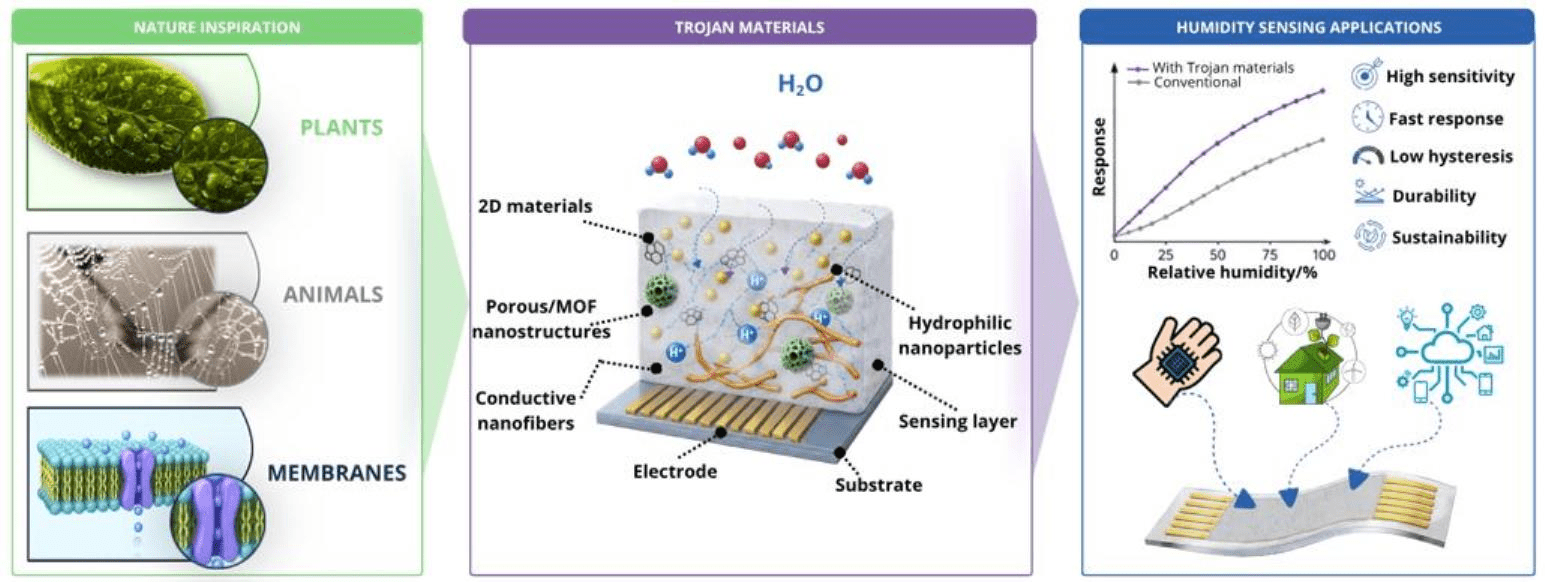
Source: Graphical abstract reproduced from Oliveira DS, Vieira ES, Martins GV, et al. Nature-Inspired Trojan Materials as Invisible Enablers of Advanced Humidity Sensors. Materials. 2026;19(11):2402. https://doi.org/10.3390/ma19112402. Reproduced under the Creative Commons Attribution 4.0 International licence (CC BY 4.0).
Within the scope of the MI3S project, and co-authored with ISEP and CeNTI, this article explores new approaches to the development of advanced humidity sensors inspired by mechanisms found in nature.
The review analyses different smart materials, including conductive polymers, polymeric composites, and hydrogels, capable of monitoring humidity changes with high sensitivity. The article also highlights the concept of Trojan Materials, materials that add functionalities at a microscopic level without altering the main structure of the system.
In addition to presenting the state of the art of currently available technologies, the publication identifies the main scientific challenges and future opportunities for increasingly precise, durable, and integrable sensors in smart construction systems.
This research provides an important foundation for the development of the monitoring solutions planned within the MI3S project, contributing to more efficient and resilient buildings, prepared for predictive maintenance.
Full article: https://www.mdpi.com/1996-1944/19/11/2402
Knowledge that generates innovation
Participation in these three scientific articles demonstrates that innovation does not happen only in the laboratory or on site. It results from collaboration between companies, universities, and research centres, enabling scientific knowledge to be transformed into solutions with real impact on the construction sector.
By taking part in projects such as EcoSys2Build and MI3S, Prudêncio contributes to the development of more sustainable and efficient technologies, prepared to respond to the future challenges of construction.
Continuing to build the future
Construction today faces challenges related to sustainability, energy efficiency, digitalisation, and building performance. Responding to these demands requires investment in research, the promotion of knowledge transfer, and the development of increasingly innovative solutions.
It is precisely along this path that Prudêncio continues to invest: bringing science, technology, and practical experience closer together to contribute to a more efficient, sustainable, and future-ready construction sector.